Showing posts with label mudras and colors. Show all posts

Sunday, August 24, 2008

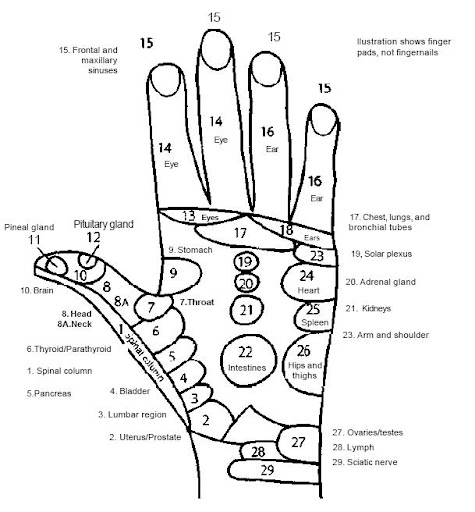
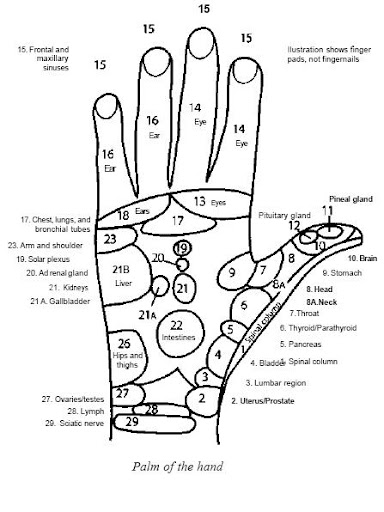
Reflex Zones in our body

The hand reflex zones correspond to the foot reflex zones, the massage treatment of which is generally known today. Both of the following illustrations show the reflex points or surfaces that are connected with the muscles and organs. Since some of the organs are only found on one side of the body (such as the heart and liver), this is reflected in the hands.


Since hands come in different sizes, you may not find the exact pressure point immediately. But with some practice, even the nonexpert can find the right spot.
When you have found the desired point, massage it with your thumb, using light pressure and slow, circular movements. One to 3 minutes are enough.


Monday, August 18, 2008

Using Yoga Mudras to heal physical complaints


Mudras used against a great variety of health disorders are primarily found in Chinese medicine. These usually have their origin in the Five Element Theory , the principles of which are still unknown in the West. However, the Indian yoga master and healer Keshav Dev, who intensively researched the effect of the mudras many years ago, can also confirm the healing power of the mudras. He says: "Your destiny lies in your hands, and this should be taken quite literally. Not only because the hand lines show the past and future of a person, but above all because each finger has its very own functions and power within the organism. If you know how to use this power, you can maintain your physical health and mental peace. When I tell patients about the mudras, their first reaction is skepticism. They ask me, 'How can my illness be improved if I do nothing more than just press together a few of my fingers?' But as soon as they begin to trust and have carried out the exercises, they feel the effect and their skepticism changes into astonishment. Then I explain to them that these techniques, which look so simple, are extremely valuable gifts that were given to us from the most enlightened yoga masters of ancient times."

Everyone who has been involved with the healing effect of the rnudras emphasizes that a sensible lifestyle and diet must absolutely be taken into consideration. An unhealthy lifestyle usually consists of inferior diet, lack of exercise, and too little fresh air, rest, and relaxation—coupled with too much stress, worry, negative thoughts, and negative feelings. Practicing the mudras, together with a healthy diet, routine rest periods, adequate exercise (yoga, jogging, hiking, biking, etc.) will naturally lead to an optimal lifestyle. And this is the basis for health. (
When mudras are used to support the healing of chronic health disorders,
they should be routinely employed as a course of treatment over a period of several weeks or months. A chronic disease has already had its beginnings within a person many years before it actually becomes evident. Consequently, a certain amount of time is required in order to dissolve the waste materials that have deposited themselves in the arteries, organs, individual
cells, and energy fields.

Some mudras can also be used as help in an emergency (for example: lumbago, dizziness, nausea, or heart attack). Practice these when they are necessary and only as long as they are necessary. Sudden complaints are not a coincidence, but are the explosion of an imbalanced state that has already flared up within us for a longer period of time. This is why a mudra shouldn't just be used like a fast-acting medication to subdue symptoms. Get to the bottom of the matter. Meditate- ask inside yourself what this physical attack means for you. Ask persistently and honestly, for then you will also receive an honest answer. Perhaps it won't be comfortable, but it
will have a healing effect in the long run.

Yoga- mudras and colors

Colors influence our minds and our lives on every level. In color
therapy, various shades of color are specifically applied to regener-
ate the organs and glands, as well as to activate the processes of
elimination, respiration, and circulation. Colors also influence our moods
and every type of mental activity.

• Red stimulates the circulation, makes us alert, warms and
relaxes, but can also bring out aggression;

• Orange improves the mood, promotes lightness, stimulates
sexuality, but can also stimulate superficiality;

• Yellow stimulates digestion, makes us mentally alert, and lets
life appear in a bright light, but it can also be obtrusive;

• Green is generally calming; it regenerates on every level, and
gives us the desire to start something new;

• Blue is also calming, but this calmness goes deeper and pro-
vides a sense of security; it conveys protection, and symbolizes t
the silent yearning for the incomprehensible;

• Violet is the color of transformation, change, and spirituality;

• Brown is the color of stability and connection to the earth, but
too much can lead to stagnation;

• White bears the entire spectrum of the other colors within
itself, containing birth as well as death;

• Black is the color of protection, of gathering strength, of
retreat, and of the emptiness that already bears abundance
within itself. Many teenagers like to wear black because they
stand at the gateway of a new period of their lives. However,
too much black weakens the organism, puts us in a sad mood,
and promotes pessimism.

There are basically no "bad" colors, but it is important to use the right pro-
portions. Every color can also be seen in our aura or energy body. When a
color gains dominance or is not in its right place, it will initially have an
effect on the general feeling of well-being. With time, a health disorder
may develop as a result. However, the course of an illness can also be
reversed with the help of colors.
It would go beyond the scope of this book to discuss the entire spectrum of colors used in healing. The following suggestions can help you have some good and beautiful experiences using color meditations. If you prefer a certain color, it may well be that you need the corresponding qual ities. However, if you give too much preference to one color, this can develop into an addiction and the color may harm you.

While holding a mudra, you can either visualize a color or concentrate on the color of an object. The first approach is better because the color will then come to life, which means you can imagine the color as dark or light, dull or bright, connected to forms, or flowing, etc. For example, you feel the need to go into the forest because you can best regenerate yourself there but don't have the time to do so. You can imagine a very green forest, and in your thoughts, you can totally luxuriate in the green of the leaves. This will refresh you inwardly. Such visualizations have long been used successfully, and pictures of lush landscapes are specifically installed in many hospitals to support the healing process. Try it out!