
With each hand: Place the thumb, middle finger, and ring finger together—extend
the other fingers. When needed, do for 5 to 45 minutes or use three times a
day for 15 minutes as a course of treatment.
This mudra supports the removal of waste materials and toxins from the body, as well as eliminating urinary problems, according to Keshav Dev. The Apan Mudra also stimulates the wood element, which is associated with the energy of the liver and gallbladder .
This element also contains the power and pleasure of springtime, of new beginnings,
of tackling and shaping visions of the future.
In addition, the Apan Mudra has a balancing effect on the mind, which is largely dependent upon a well-functioning liver. It gives us patience, serenity, confidence, inner balance, and harmony. In the mental realm, it creates the ability to develop vision. You need all of this when you look into the future, while facing new challenges, and if your wishes are to
be fulfilled.
Saturday, August 30, 2008
Apan Mudra - mudra of Energy

Friday, August 29, 2008
Pran Mudra

With each hand: Place the tips of the thumb, ring finger, and little finger together. The
other fingers remain extended. As needed, use for 5 to 30 minutes. Or, as a course of
treatment, do three times a day for 15 minutes.
The Pran Mudra activates the root chakra , in which the elemental force of a human being is found. I like to compare this place with a fire that is either ablaze or just glows quietly. How brightly
the fire burns depends on how well we tend it. This finger position stimulates
the nourishing energy in the pelvic floor. The Pran Mudra generally increases vitality, reduces fatigue and nervousness, and improves vision. It is also used against eye diseases. On the
mental-emotional level, it increases our staying power and assertiveness, healthy self-confidence, gives us the courage to start something new, and the strength to see things through. Clear eyes are also a sign of a mental outlook emphasizing clarity and a clear mind, which means clearly structured thoughts and ideas.
According to Kim da Silva, when you do the Pran Mudra you can also put your thumb onto the fingernails of the other two fingers instead of on their tips. This has the effect of causing both the right and left brain hemispheres to function equally, become active, and mutually complement each other, which is very important for holistic health.
Bronchial Mudra - respiratory problems

Both hands: Place the little finger at the base of the thumb, the ring finger on the upper thumb
joint, and the middle finger on the pad of the thumb. Extend the index finger. For an acute attack of asthma, first use this mudra from 4 to 6 minutes and then practice the Asthma Mudra (Number 5) until breathing has become normal again. For a long-term treatment, hold both
mudras for 5 minutes, five times a day.
People with respiratory problems often also suffer from inner loneliness, isolation, sexual problems, and sadness. To the outside world, these feelings are often successfully played down with humor. Or these individuals bind themselves to others by taking on their duties and concerns. This naturally causes a great deal of stress so that these individuals are pressed for time and out of breath. Since I am all too familiar with such problems, I can perhaps advise you how to get out of this dilemma. It is important to admit your negative feelings and moods for once and take a good look at them. Be aware that even these feelings are like waves on the surface of the water—they arise and then pass on. The reason for such feelings is often a
general weakness that is caused by shallow breathing since improper respiration
doesn't build up the inner reservoir of strength. When it is reduced, weakness occurs not only on the physical level but also in the mental-emotional area. Fear, sadness, discontentment, exaggerated sensitivity, etc., are the consequences.
Tuesday, August 26, 2008
Ushas Mudra

Break of day—origin of all good things
Clasp your fingers so your right thumb lies above the left. The right thumb presses slightly on
the left thumb. Important: Women should place the right thumb between the
left thumb and index finger, pressing on it with the left thumb. Do this every day for 5 to 15 minutes. Hold this mudra until the desired effect occurs. No matter how old we are, there are times of change: new beginnings come repeatedly in life. The second chakra, our center of sexuality and creativity, always contains something new, a secret that wants to be aired. This mudra concentrates the sexual energy of our second chakra and directs it into the energy centers above it. It gives us mental alertness, pleasure, and new impulses. In addition, it harmonizes our hormonal system. The Ushas Mudra helps us wake up in the morning. When you are still sleepy and lying in bed, place your clasped hands at the back of your head. Now inhale vigorously and deeply several times; open your eyes and mouth widely; press your elbows back into the pillow. While exhaling, let go of every tension. Repeat 6 times. If this still doesn't make you feel alert and fresh, then rub your ankle bones together, as well as the palms of your hands, as if you were trying to ignite a flintstone. Finally, you can also extend your arms and stretch vigorously.
In your imagination, see yourself sitting in a good place where you can
enjoy the sunrise. The sun slowly rises, and you let the colors red,
orange, and yellow have their effect on you for a long time. These colors
awaken and improve your mood. Now imagine yourself as a person
who is full of youthful strength and new impulses, as someone
who enjoys life, a person who goes out into the world with love, and
richly blesses it with a sincere smile, good deeds, and beautiful things.
Monday, August 25, 2008
Meditation 2: Index Finger Energy
are associated with this finger. Here we also find the "sure" instinct,
having "a good nose," the ability to reflect, and inspiration. This energy
goes to our innermost core and back to the cosmos from there. We can also
draw on our innermost being (intuition) and receive from the cosmos
(inspiration). This finger includes both closeness and expansiveness. How
much closeness can we stand?
The air element represents the mind—the power of thought.
Thoughts are as invisible as the air and yet, as the yogis have discovered,
they are the cause of all the actions that we take or refrain from taking, of
everything that we reject and attract, for our health and for every mood,
and for the entire design of our life. The planetary power of Jupiter is also
associated with this finger, and indicates the eternal change of things—
accepting life with all its facets, working through (digesting), and letting
go again.
There is also a clear, purposeful look into the future in this finger.
Since our thoughts are so important, we should consider their quality more
frequently. If we do the following meditation several days in a row, we will
notice that there is a certain habit in our thoughts. Habits can be changed
as soon as we become aware of them, but changes always require a certain
amount of time. If we continuously replace harmful thoughts with useful
ones, we can also change the circumstances of life accordingly.
Yoga mudras for Recharging Energy Reserves
The following mudras have an especially stimulating and restorative
effect: 2, 3, 4, 6, 13, 21, 22, 27, 28, 29, 31,35, 36, and 39.
continure reading posts of yoga training teacher for next
Yoga Mudras and Meditation
Just like Christian prayer expresses itself through words and corresponding gestures, the Eastern religions also use gestures, Yoga training teachers use mudras, to support the prayer. The meaning and purpose of meditation are also supported by the mudras. In this respect, the Hindus have developed a very differentiated and complete system. In fact, it is so complicated and elaborate that many believers can no longer cope with it and require the help of a priest.
Meditation, as I understand and practice it, has become an indispensable aid in my life. I use it at any time, and everywhere, for everything. As a result, I bring clarity, light, and lightness into my life. I recharge my inner batteries and solve my problems, make decisions, get advice and comfort, refine my character traits, mobilize my immune forces, develop visions for the future—and seek my connection with the Divine. We can
use meditation for everything, which includes dissolving anything that bothers, burdens, or annoys us, as well as achieving inner and outer wealth—and naturally also for achieving our spiritual goals. Let's make full use of these possibilities!
Continue reading next Posts of Yoga training Teacher [dot] blogspot [dot] com
Sunday, August 24, 2008
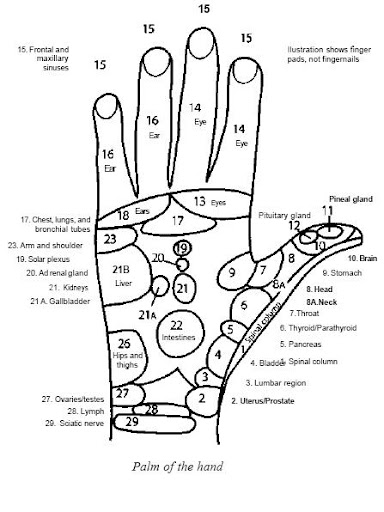
Reflex Zones in our body
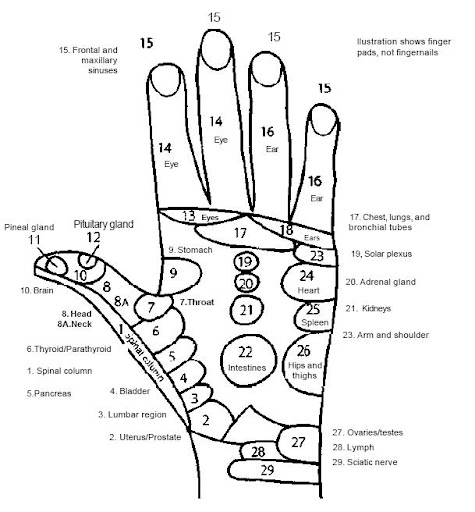
Since hands come in different sizes, you may not find the exact pressure point immediately. But with some practice, even the nonexpert can find the right spot.
When you have found the desired point, massage it with your thumb, using light pressure and slow, circular movements. One to 3 minutes are enough.
Acupressure and Healing
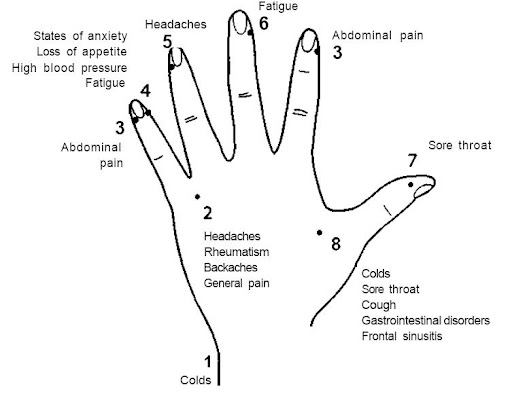
If vou have high blood pressure, massage the middle finger from the root to the tip. To counteract low blood pressure, massage the middle finger from the tip to the root. Do the same with the index finger if you have diarrhea or constipation.
Monday, August 18, 2008
Yoga Mudras and Healing Emotional problems
Mudras do true wonders in this field. For a number of years now, hand exercises have been successfully used on children in special education classes. Run your thumb along your fingertips in a gentle and conscious way.

This feels wonderful! It's refreshing for your brain. The brain should be trained like a muscle every day. It has been proved that even after a few days of rest in bed (after an operation, for example), the activity of the brain is reduced. It has also been demonstrated that the brain can regenerate very quickly through the appropriate training. Practicing mudras can be called pure brain training. There is a positive influence on the brain waves, particularly when the fingertips touch each other. When we visualize inner images at the same time, this requires a great deal of ability from the brain and promotes the power of the imagination. This power is one of the reconditions for mental alertness and clear thinking.
The accompanying affirmations promote a clear manner of expression, which is also a mental power. When a mudra is done with full concentration, and a state of serenity is maintained, cerebral activity is
calmed and regenerated. In addition, many mudras synchronize the right and left hemisphere of the brain. This promotes memory, the general ability to recollect, and, miraculously, creativity as well. I will risk claiming that a trained brain remains fit up into a ripe old age. The great yogis have also demonstrated this to us with their mental
alertness as seniors. I can also observe—and my surrounding world has confirmed this—that my own ability to recollect, my memory, clear thinking, and concentration have never been so pronounced as today. Colleagues who are as old as I am complain about the opposite. And I am no more talented than they are! The only difference is that I constantly train my brain. Always see the good in your fellow human beings, put the negative aspects of the past behind you, live completely in the present, and make the best you possibly can of it. Expect the best from the future and remain in constant contact with cosmic consciousness—then nothing will stand in the way of a meaningful and happy life. I can hardly describe the blessings that this kind of constructive thinking has brought me. Incidentally, this attitude in life is also the best for my health. Mudras have a wondrous effect on the emotional area of our lives, which includes the soul, our feelings, and our moods. It is no coincidence that people make fists when they are vehemently agitated, or that hands become limp and their movements flighty during depressions. If we want to change oppressive moods, we can do so by changing our breathing rhythm accordingly. The way we breathe can stimulate us, calm us, inflame us, or cool us down.
Yoga- mudras and colors
Colors influence our minds and our lives on every level. In color
therapy, various shades of color are specifically applied to regener-
ate the organs and glands, as well as to activate the processes of
elimination, respiration, and circulation. Colors also influence our moods
and every type of mental activity.
• Red stimulates the circulation, makes us alert, warms and
relaxes, but can also bring out aggression;
• Orange improves the mood, promotes lightness, stimulates
sexuality, but can also stimulate superficiality;
• Yellow stimulates digestion, makes us mentally alert, and lets
life appear in a bright light, but it can also be obtrusive;
• Green is generally calming; it regenerates on every level, and
gives us the desire to start something new;
• Blue is also calming, but this calmness goes deeper and pro-
vides a sense of security; it conveys protection, and symbolizes t
the silent yearning for the incomprehensible;
• Violet is the color of transformation, change, and spirituality;
• Brown is the color of stability and connection to the earth, but
too much can lead to stagnation;
• White bears the entire spectrum of the other colors within
itself, containing birth as well as death;
• Black is the color of protection, of gathering strength, of
retreat, and of the emptiness that already bears abundance
within itself. Many teenagers like to wear black because they
stand at the gateway of a new period of their lives. However,
too much black weakens the organism, puts us in a sad mood,
and promotes pessimism.
There are basically no "bad" colors, but it is important to use the right pro-
portions. Every color can also be seen in our aura or energy body. When a
color gains dominance or is not in its right place, it will initially have an
effect on the general feeling of well-being. With time, a health disorder
may develop as a result. However, the course of an illness can also be
reversed with the help of colors.
It would go beyond the scope of this book to discuss the entire spectrum of colors used in healing. The following suggestions can help you have some good and beautiful experiences using color meditations. If you prefer a certain color, it may well be that you need the corresponding qual ities. However, if you give too much preference to one color, this can develop into an addiction and the color may harm you.
While holding a mudra, you can either visualize a color or concentrate on the color of an object. The first approach is better because the color will then come to life, which means you can imagine the color as dark or light, dull or bright, connected to forms, or flowing, etc. For example, you feel the need to go into the forest because you can best regenerate yourself there but don't have the time to do so. You can imagine a very green forest, and in your thoughts, you can totally luxuriate in the green of the leaves. This will refresh you inwardly. Such visualizations have long been used successfully, and pictures of lush landscapes are specifically installed in many hospitals to support the healing process. Try it out!
Sunday, August 17, 2008
Yoga - mudras and music

Some clinics and rehabilitation centers use music as a component of routine therapy. We all know the healing effect of music, as a number of books have been published on the subject. But music is also good for healthy people who are occasionally plagued by weakness or physical imbalances. Since the music used for therapy plays anywhere from three to twelve minutes, and this amount of time corresponds to how long one holds a mudra, it is obvious that mudras and music can have a wonderful influence on each other.
Tension—either physical or mental-emotional— can be relieved by listening to the right kind of music. The right kind of music has a calming and relaxing effect, possibly even taking a person into a state of deep relaxation. Stress and tension can also lead to an acute or a chronic state of exhaustion that can be positively influenced by music.
If you pay attention to the following points, you can get a lot from using music with your mudras:
• Consider your own taste in music;
• Determine how long the playing time should be;
• Listen to the same piece at the same time for at least three days
in row;
• Listen consciously, and immediately let go of any thoughts
that may arise.
Which music pieces are best suited for this purpose? Helen Bonny, who developed GIM (Guided Imagery Music), writes: "Tranquilizing and relaxing music is oriented to the human heart, on a calm and relaxed pulse. Overall, tranquilizing music is distinctly calm and more harmonious, with
lightly flowing melodies. A person doesn't have to immediately fall asleep to it, but this music promotes specific feelings, such as an inner calm, relaxation, and contentment."7
According to the opinion of the GIM trainer, classical music is particularly
suited for healing and relaxing, and solo concerts have a stronger
effect than symphonies. There is a special power in slow movements—
andante, adagio, and largo. For a relaxation effect, the most suitable instrument
is the oboe, followed by the piano, the cello, the violin, the clarinet,
and the organ. Vocals are less suited for promoting relaxation. The following
keys are the most effective: C major, D major, B major, and F
major. In summary, it can be said that many low and few high frequencies
lead to relaxation. High freq uency, "airy" music tends to be more suited for
a light, elevating mood. With these guidelines, you can now put together
your own appropriate and individual music pharmacy.
It is worthwhile to find out which music especially appeals to you so
you can become more conscious of your own individuality in this respect.
For example, some relaxation music has precisely the opposite effect on
me—it gets on my nerves, and even makes me feel aggressive.
Incidentally, if you have trouble taking the time to do chores around
the house, try playing some snappy marches or hot rock music, or even
techno, to bring fresh momentum into this bothersome situation!
BREATHING, VISUALIZATION, AND AFFIRMATIONS TO ENHANCE THE MUDRAS
The effect of a mudra can be immensely intensified with the breath. This is why it is very important to know what breathing does. When you understand the following principles, then you
can influence the effect of a mudra according to your own needs.
• Pay attention to a symmetrical posture and hold your arms about one inch away from your body. Even this position alone brings a sense of inner equilibrium and harmony as it regulates
the activity of the nervous system and hormonal glands.
• In addition to carbon dioxide, we also discharge expended energy on the subtle level when we exhale deeply. This is why you should always exhale vigorously several times at the beginning of a mudra. Make room for what you want to achieve.
• Always lengthen the little pause after inhaling and after exhaling by several seconds. This is the most important aspect of the breathing process. The inner powers are developed
during the pauses—on every level.
• When you practice a mudra to calm yourself, then slow your breathing.
• When you practice a mudra to refresh yourself, then intensify your breathing.
• The optimal quality of breathing is achieved when the breath is slow, deep, rhythmic, flowing, and fine.
At the beginning of a mudra meditation, exhale vigorously several times and then let the breath become deeper and slower. You now have three possibilities:
First: Focus on your hands and fingers, perceive the gentle pressure
where they touch each other;
Second: While inhaling, you can press the fingertips together a
bit more and let go of the pressure when exhaling;
Third: You can do it the other way around and apply a bit
more pressure while exhaling and let go of the pressure when
inhaling.
Every variation has its special effect. The first variation centers, creates inner equilibrium, and builds up strength in general. The second variation strengthens the will and refreshes. The third variation calms and relaxes. Try out these variations and feel the difference yourself! It is possible that you won't immediately feel the effect, but it is still there. The outer circumstances of our lives usually shape themselves according to our imagination and the contents of our minds. So we have the possibility of shaping our inner images in such a way that we enjoy life, experience success in our work, and have relationships on a loving and understanding basis. It is very important to create an unshakable faith and be filled with both fervor and serenity to accompany our self-made images.
We need to create little experiences of success for ourselves, since what functions in a small way will also succeed on a larger scale. We can slowly build and develop this confidence. Just imagine what would happen if a great many people would simultaneously imagine a beautiful world with
rich flora, content animals, happy human beings, and firmly believe that this is possible. Join in—then there will already be two of us!
If we can clearly express what we do not want and definitively formulate our wishes and needs, this can already be the beginning of a new order in life. For many years now, I have worked with affirmations— sometimes more, sometimes less. Time and time again, their astounding effects have astonished me. For example, my kitten disappeared one day. I repeated the same sentence over and over the entire day: "With divine strength and power, I find my kitten again." Toward evening, I simply knew where my kitten was. The woman was completely perplexed when I claimed that my cat was in her garage, but it was true. It is so simple, and some people even find it a bit naive. But things that are particularly simple and naive usually have the greatest effective power. The same principle applies to affirmations as it does to visualizations. Say them full of faith, fervor, and serenity. You can say them one to three times, during or after the meditation. You can also pause for a moment during the day and speak your affirmation in a quiet or a loud voice. Make use of this wonderful possibility and talk yourself into what you really want—what is good for you. If you want to get rid of something stubborn, a negation can also be helpful. Speak it at the beginning, while you are vigorously exhaling. For example, "This hatred (or resentment, feeling of guilt, pain, fear, desire to smoke, etc.) will immediately disappear and dissolve itself"
How Long is a Yoga Mudra Held?

The great masters do not agree on the length of time to practice a mudra position. The Indian mudra researcher Keshav Dev recommends holding one mudra per day for 45 minutes; chronic complaints can be eliminated in this way.6 If it isn't possible to do this, these 45 minutes can be divided into three time periods of 15 minutes each. The kinesiologist Kim da Silva, who has tested the effect of mudras over longer periods of time, recommends an individually, precisely determined time for holding each mudra. If you use a mudra as support for some type of therapy or to heal a chronic complaint, then I think it is beneficial to use it routinely, like a medication: every day at the same time and for the same length of time. Mudras that are used for acute complaints—such as respiratory and circulation problems, flatulence, exhaustion, or inner restlessness—should be discontinued when the appropriate effect is achieved. Other mudras can be practiced for 3 to 30 minutes, two to four times a day. Using a stopwatch is the ideal way to time them. The time specifications that I have assigned to the individual mudras are meant to be an orientation aid, but not a dogma. You will also notice that your hands, especially the fingers, will become increasingly sensitive and respond to the mudras much more quickly after they have been given some training. If you need 5 minutes at the start to feel the effect of a mudra, in time you will only need 10 breaths. This is a wonderful experience! However, if you are confined to your bed, then you have enough time and should permit yourself to make good use of it. Also let the visualizations and affirmations continue to have their lasting effect afterward. You can use this time for your own benefit, for the healing of the body, mind, and soul.
The effect of a mudra may be perceived immediately or only after a certain amount of time. You start to feel warm, the sense of unwellness and pain fade away, your mood improves, and your mind is refreshed. But exactly the opposite may occur at the start. You become tired, or start to feel cold and shiver. This is also a positive sign of the effect.
Where and When Can You Practice Yoga Mudras?

You can actually practice the mudras at any time and in any place. Modern authors take the view that mudras can even be done while stuck in traffic, watching television, or when you have to wait for someone or something. However, my opinion differs somewhat from this perspective for the following reasons: mudras should be done in a meditative, harmonious mood. Can you guarantee that while stuck in traffic you won't be stressed and fuming with annoyance because you aren't getting to where you want to go, or that you sit in front of the television because you are "relaxing" by watching a hard-core thriller or vehement political debate on taxes? I invite you to do an interesting test: place your thumb and index finger together and think about something wonderful for a few minutes while you do this (an experience in nature, winning at sports, sex, etc.)—it doesn't matter what it is, as long as it lets you float on pink clouds. Now
try to feel the energy that flows from the index finger to the thumb. Finished! Now do the same thing again, but this time imagine something terribly sad. Once again, feel the energy of the fingers. Do you notice a difference? You will certainly have discovered how dull the flow of energy felt the second time.
This little experiment shows me how important it is to practice mudras while in a good mood and in a positive atmosphere. Feelings and thoughts influence the energy fields and the flow of energy in a negative or positive manner, even if we don't notice it. This is no joking matter. As I will explain later, we want to engage these energy fields in a positive sense. This is why the basic tone of our momentary mood and situation is so important. However, there are also mudras and breathing techniques for serenity, patience, and composure. These can be used to initially get into the right mood. For example, when stuck in traffic, standing in line, or sitting on a
train, we can first calm down and then begin practicing the actual mudra. When holding a mudra while watching television or listening to the radio, one further factor should be taken into consideration—the time we spend on a mudra should always be a time of self-communion as well. The only exceptions are special programs or music with a much more calming
than stimulating effect on the nerves. If we have planned our days so poorly
that we don't have three peaceful minutes, if we let ourselves constantly
be exposed to the radio or television from our first waking moments until
we fall asleep at night, then mudras actually have no place in our lives.
Mudras can truly be practiced almost anywhere and at any time, but
only when we can also withdraw within ourselves almost anywhere and at
any time. This really isn't all that difficult and can be learned, like everything
else. It concerns our health—we need a few silent minutes now and
then every day. These silent moments can be the most precious to us; and
like the salt in the dough that gives the bread its good taste, silence adds the
right spice to our lives. "
A good time to practice mudras is a few minutes before getting up
and a few minutes before falling asleep, before or after meals, when you
walk somewhere (we all need to walk a certain distance every day), while
on public transportation, or during breaks at work. However, don't just try out a number of mudras in a row at random.
Specifically select just one or two. Practice these according to a time plan.
Decide when, how long, and how often you want to do them every day. Or
plan to fill both the usual and unpredictable times with them when you
have to wait. Practice only these mudras over the next few days. The effects may occur immediately, especially if you have acute complaints or mood swings. But it may also be that the effects you hope for only occur after several days. For chronic complaints, it usually takes several weeks or even months before an improvement takes place. Only patience can help
here. Moreover, it is always worth it since many new perceptions can be
gained and wonderful moments experienced, in addition to the desired
healing. You should also know that when something changes within, there
is a corresponding change in your surrounding world. Every healing within also brings healing into your world. An illness in the body is always connected with thoughts and feelings that make people sick. A certain amount of time is required before healing takes place on every level. So allow yourself the time—practice ardently and remain completely serene and confident while doing so. Then the chances of healing will be the greatest.
How Are Mudras Practiced?

Quite simply: Form your hands and place the fingers as they are shown in
the various illustrations. When you do this, the pressure of the fingers should
be very light and fine, and your hands should be relaxed. But perhaps you may
notice that this isn't all that simple! The fingers are rebellious, too inflexible,
and the hands slip away or tire quickly. The flexibility of the hands has
a direct relationship to the flexibility of the entire body. If we are tense at a
certain place in the body, this tension will be expressed at a corresponding area in the hands. Even a person's age can be determined on the basis of the
spread fingers—at least this is what the Chinese healing practitioners claim.
My body and my hands have become very flexible through many
years of yoga practice. Yet, I can only do the mudra against backaches,
which I need the most, with one hand because I have to use the other to
hold the fingers in position. At the beginning, you may perhaps also have
problems in doing some of the mudras with both hands because you will
first have to arrange and hold the fingers of one hand with the other. If this
is the case, just do the mudra with the one hand for the time being. If the
fingers that should actually be stretched curl on their own again, simply
press them onto your thigh or some other place where you can rest them.
With time, the tensions will dissolve in the fingers or hand, as well as in the
corresponding area of the body.
Do the mudra as well as possible and the effect will appear in any
case. In the beginning, it may be difficult to keep the fingers extended.
When the fingers get tired, they give in. With time, I am certain that you
will gain more strength in your hands, become more flexible, and will be
able to use both hands. You will also feel more refreshed and flexible. It is
also possible that you will feel somewhat younger.
Even when you have become stronger and more flexible, always treat
your fingers in a careful and loving way. It doesn't matter why you are
doing the mudra, it should not only be a healing gesture, but also a holy
gesture.
Mudras can be done while seated, lying down, standing, and walking.
Be sure that your body posture is symmetrical and centered, and that
you are as relaxed and loose as possible. If you sit on a chair while doing
them, your back should be straight and your feet should have good contact
with the floor. If you do them while lying down, resting on your back is
naturally the most suitable position. If you stay in this position for a long
period of time, put a small pillow beneath the back of your head to take the
strain off the neck. To relieve your back, you can put a cushion under the hollow of the knee or thigh. It
is important to remain comfortable and relaxed, for any tension will also hinder the inner flow of energy and we want something new to flow with the mudras. If you do them while walking, make sure you move in an even, calm, and rhythmic way. If you stand while doing them,
keep your legs shoulder distance apart. The knees should be relaxed, and the tips of the toes must point forward. If you have a bit more time, you can also do the mudras in a seated
meditation position—this will turn them into a longer period of meditation.
When you do this, take into consideration the following basic principles
of meditation technique:
• Sit with an upright pelvis and a straight spinal column on a
stable cushion. Both knees should be flat on the ground or at
the same height (if necessary, support the lower knee with a
cushion until it is at the same height as the other knee).
• Let the hands relax on the thighs.
• Let the shoulders fall back and down in a relaxed way; your
chest should be open and free.
• Pull the chin back a bit, and let the neck be long and relaxed.
• Breathe in an even, slow, flowing, and gentle way.
• Never end the meditation suddenly. Always vigorously
stretch your arms and legs.
You can also form a mudra and think of something else at the same time.
However, I have found that the effect is accelerated and intensified when
you simultaneously assume a meditative position, focus on your hands, and
observe your breathing. Observing the normal flow of the breath or influencing
and directing the breath is a very important way of supporting the
mudra. How to do this is explained for the individual mudras.
Corresponding visualizations and affirmations can be used so that this
never becomes just a routine matter. These also intensify the effects of the
mudras. For some exercises, I am no longer certain what has the greatest
effect—the mudra, the breathing technique, the visualized image, or the
spoken word. But who cares? It fulfills its purpose, lets you feel good, and
makes you happy!
Origin of Yoga mudras
The origin of the mudras is a mystery. Mudras are not only found
in Asia, but they are also used throughout the entire world. In
their rituals, our European ancestors certainly were familiar with
specific gestures, which they used to underline and seal what they thought
and wanted to say. During the Christianization of the Nordic peoples,
many gestures were initially prohibited, such as invoking the gods with
raised arms. Later, these gestures were partially integrated into the
Christian teachings. If we observe the various gestures made by a priest
saying the Mass, we can perhaps sense how these ancient peoples expressed
themselves. But our everyday life is also characterized by gestures, the origins
of which hardly anyone knows today: crossing our fingers for someone,
clapping our hands as applause, the handshake, holding hands, or
"giving someone the finger" to display our low opinion of them.
In India, mudras are an established component of all religious activities.
The various mudras and hastas (arm poses) are significant in the
depiction of Hindu gods. In addition to body postures and attributes, they
also represent the distinguishing characteristics of various deities. The person
at prayer sees a special power, capability, and strength of character in
these mystical hand poses. The best-known mudras of the major gods
Brahma (Creator), Vishnu (Preserver), and Shiva (Destroyer) are numbers
41, 42, 43, 46, 47, and 48.
The mudras are just as familiar in Indian dance, where the hands,
eyes, and body movements act and/or dance the entire drama without words. Mudra specialist Ingrid Ramm-Bonwitt describes this beautifully,
"The hands are the bearers of important symbols, which are still universally
understood in the East today. With his or her hands, the Indian dancer
expresses the life of the universe. Through its variety of interpretive possibilities,
the rich symbolism of the dance's language of gestures gains a
greater significance for the mind than words could express. . . . The spiritual
meaning of the mudras found its perfect expression in Indian art. The
gestures of the deities depicted in Hindu and Buddhist art . . . symbolize
their functions or evoke specific mythological occurrences."4
Mudras are also practiced in Tantric rituals.5 They play a large role
in Buddhism, where six mudras are very familiar in the pictorial depictions
of Gautama Buddha. These are very closely related to his teachings
and his life (see mudra numbers 41, 43, 46, 47, 48, and 49).
Hatha Yoga also expresses the many states of mind, such as mourning,
joy, anger, and serenity, through gestures and body positions. They
realize that the reverse also applies—certain gestures can positively influence
the psyche.
What are mudras in Yoga?

Mudra is a term with many meanings. It is used to signify a gesture, a mystic position of the hands, a seal, or even a symbol. However, there are eye positions, body postures, and breathing techniques that are called mudras. These symbolic finger, eye, and body postures can vividly depict certain states or processes of consciousness.
Conversely, specific positions can also lead to the states of consciousness
that they symbolize. What does this mean in concrete terms?
For example, a person who frequently and fervently does the gesture of
fearlessness, which can often be seen in the depiction of Indian deities, will
also be freed from fearfulness with time. So mudras engage certain areas
of the brain and/or soul and exercise a corresponding influence on them.
However, mudras are also effective on the physical level. I discuss this in
the section called "Mudras and Other Hand Therapies."
We can effectively engage and influence our body and our mind by
bending, crossing, extending, or touching the fingers with other fingers.
Isn't this wonderful?
In Hatha Yoga,1 there are 25 mudras. These also include eye and
body positions (asanas) and locks (bandhas). In this book, I will only briefly
touch on them and mainly describe the hand mudras. Especially in Kundalini Yoga,2 the hand mudras are used during the body postures to
intensify their effect. The kundalini expert Lothar-Riidiger Liitge
explains: "In this respect, Kundalini Yoga assumes that every area of the
hand forms a reflex zone for an associated part of the body and the brain.
In this way, we can consider the hands to be a mirror for our body and our
mind."
As I recently meditated on the term mudra, I became particularly
aware of the symbol of a lock. A lock always conceals a secret. We frequently
use gestures in an unconscious way to seal something; for example,
when giving special weight to a decision, or reaching an agreement with
another person, or even with cosmic consciousness. In precisely the same
way, we may also seal something with our inner forces—we reach an understanding
with ourselves. I don't believe we will ever completely understand
the essence of the mudras. The enigmatic touches on the Divine—so each
mudra ultimately creates a special connection to cosmic consciousness (or
however you prefer to call the Divine). This symbolism, in particular, is the
basis of the best-known hand mudra of yoga, the Chin Mudra.
The thumb is symbolic of cosmic (divine) and the index finger is symbolic of individual (human) consciousness. The ultimate or primary goal of yoga is the oneness of humanity with cosmic consciousness. With this gesture, the human being expresses this desire, this longing. It is interesting to note that both these fingers belong to the metal element in
Chinese Five Element Theory (see Appendix C for more about this topic).
Metal is the material that is the best conductor—it conducts energy.
According to this teaching, the metal element also creates the connection
with the cosmic world, and inspiration and intuition dwell in this element.
The index finger represents inspiration (energy from the outside) and the
thumb stands for intuition (inner energy). In this gesture, intuition and
inspiration form a closed unity. The power of the microcosm and the
macrocosm are connected and mutually fructify each other. We see that if
we dig into the depths of the ancient teachings long enough—or go far
enough into the heights—we will find ourselves at the other end again.