
Break of day—origin of all good things
Clasp your fingers so your right thumb lies above the left. The right thumb presses slightly on
the left thumb. Important: Women should place the right thumb between the
left thumb and index finger, pressing on it with the left thumb. Do this every day for 5 to 15 minutes. Hold this mudra until the desired effect occurs. No matter how old we are, there are times of change: new beginnings come repeatedly in life. The second chakra, our center of sexuality and creativity, always contains something new, a secret that wants to be aired. This mudra concentrates the sexual energy of our second chakra and directs it into the energy centers above it. It gives us mental alertness, pleasure, and new impulses. In addition, it harmonizes our hormonal system. The Ushas Mudra helps us wake up in the morning. When you are still sleepy and lying in bed, place your clasped hands at the back of your head. Now inhale vigorously and deeply several times; open your eyes and mouth widely; press your elbows back into the pillow. While exhaling, let go of every tension. Repeat 6 times. If this still doesn't make you feel alert and fresh, then rub your ankle bones together, as well as the palms of your hands, as if you were trying to ignite a flintstone. Finally, you can also extend your arms and stretch vigorously.
In your imagination, see yourself sitting in a good place where you can
enjoy the sunrise. The sun slowly rises, and you let the colors red,
orange, and yellow have their effect on you for a long time. These colors
awaken and improve your mood. Now imagine yourself as a person
who is full of youthful strength and new impulses, as someone
who enjoys life, a person who goes out into the world with love, and
richly blesses it with a sincere smile, good deeds, and beautiful things.
Tuesday, August 26, 2008
Ushas Mudra

Monday, August 25, 2008
Meditation 5: Little Finger Energy
with the little finger. It deals with interpersonal relationships in general, as
well as partnership in particular. This classification of sexuality corresponds
with Hatha Yoga. (In Buddhism, sexuality is associated with the
ring finger.) It also contains the ability to communicate. Since the Chinese
healing practitioners found the heart meridian to be in this finger, this confirms
the yogis' thesis relating the water element to it (water symbolizes the
realm of the emotions). Joyful, fulfilling relationships not only warm the
heart, but also nourish and strengthen it. And, in turn, strong heart energy
gives us the ability to be happy. It gives us sublime feelings and improves
our mood. Our mood, which is always the sum of present feelings, can be
compared with the waves on the surface of a lake. They are rhythmically
harmonious or vehement; the water is clear and clean, or shallow, heavy,
dark and dirty.
Sit or lie down. Now encircle your left little finger with the four fingers of
your right hand, with your right thumb extending to the middle of your
left hand. Close your eyes.
In your mind's eye, you are sitting by the sea and observing the
waves—they come toward you, and roll back out and disappear.
The same applies to your feelings, moods, and also to your relationships
with others. Giving and receiving love is also subject to this
law. Be aware that you only receive as much love as you can unconditionally
give. This doesn't even have to mean great deeds. A
friendly, warm heart for fellow human beings, animals, plants,
water, air, and earth are entirely enough. Imagine someone (someone
specific or in general) happy and encourage him or her, if necessary.
Believe in this individual's abilities and good heart. Imagine
entire scenes in which this person is cheerful and smiling happily. If
you have no one close to you, then do this little exercise—perhaps
while riding the bus, train, or streetcar—in relation to a stranger. I
guarantee that you will experience wonders if you keep this up for
several days or weeks. The time will come when your heart will
overflow with joy. But the most important thing is: don't expect
anything at all for the time being. Radiate your goodwill and your
love unconditionally. Just have some patience until the seeds sprout.
Continue holding your little finger for a while and feel the flowing
warmth. Then encircle your right little finger and hold it for the same
amount of time.
Meditation 3: Middle Finger Energy
chakra. Take a look at it. It is the longest finger, and towers over the others.
Its energy radiates far into infinity. It could also be considered the stairway
to Heaven. Saturn, which is classified with it, is located toward the
edge of our solar system and is also called the "keeper of the threshold."
We are held accountable for our lives at the gates of Heaven. We also find
this symbolism in the throat chakra, the gateway of purity, which only nens when the student is pure in spirit and in heart. However, in order to
ogress on our spiritual path, we must first fulfill our duties on Earth.
This is indicated by its inherent meridians: the circulation meridian and
the deep meridian of the gallbladder. Both help us seize and master the
challenges of life. Drive, activity, risk, and the joy of taking action are their
dualities. The spectrum of the middle-finger energy ranges from an active
life to spheres far into the world beyond. It could be briefly summarized
with the following saying, "God helps those who help themselves."
Exercise
Sit or lie down. Now encircle your right middle finger with the four fingers
of your left hand. The left thumb extends to the middle of your right
hand. Close your eyes.
Imagine yourself doing what you like to do most. Make full use of
your inclinations and talents as you master all the obstacles placed
in your path, and enjoy your activities. You are successful at what
you do and mentally envision what your success looks like. What
you do enriches the world (your family, individual human beings,
or the entire world). Extensively imagine the constant contact with
the divine forces that help you and show you the way.
If your occupation does not satisfy you and if you have no leisure
activities or interests that suit you, then it is time to ask within, to
press your inner wisdom until you receive an answer. At the same
time, also askfor the initiative, which the middle finger symbolizes,
to actually tackle the matter at hand. And, above all, request help
from the divine powers—enter into a close, trusting partnership
with them.
Keep holding your finger in silence for a while and feel the warmth flowing into you. Then encircle your left middle finger and hold it for a while.
These hand positions also have an excellent effect on tension in the neck.
Yoga Mudras and Meditation
Just like Christian prayer expresses itself through words and corresponding gestures, the Eastern religions also use gestures, Yoga training teachers use mudras, to support the prayer. The meaning and purpose of meditation are also supported by the mudras. In this respect, the Hindus have developed a very differentiated and complete system. In fact, it is so complicated and elaborate that many believers can no longer cope with it and require the help of a priest.
Meditation, as I understand and practice it, has become an indispensable aid in my life. I use it at any time, and everywhere, for everything. As a result, I bring clarity, light, and lightness into my life. I recharge my inner batteries and solve my problems, make decisions, get advice and comfort, refine my character traits, mobilize my immune forces, develop visions for the future—and seek my connection with the Divine. We can
use meditation for everything, which includes dissolving anything that bothers, burdens, or annoys us, as well as achieving inner and outer wealth—and naturally also for achieving our spiritual goals. Let's make full use of these possibilities!
Continue reading next Posts of Yoga training Teacher [dot] blogspot [dot] com
Palmistry and Yoga mudras
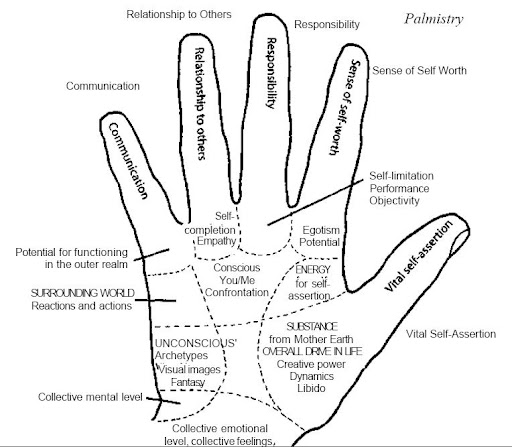 of beauty, and inner clarity; in the ring finger, there is sense of family, the ability to love, and a feeling of security; initiative, sobriety, and the love of order are found in the middle finger; intellectual faculty, individuality, and striving for power are in the index finger; the will, instinctiveness, and vitality in general are found in the thumb. Further classifications from astrology and palmistry can be found in the illustrations on page 38 and the one below.As you can see, you have "a great deal in your hands" with the mudras. You can take hold of your life with your own two hands and decide what is important to you.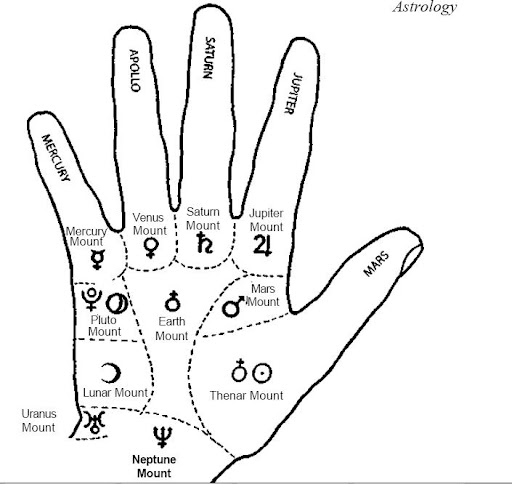
Sunday, August 24, 2008
Acupressure and Healing
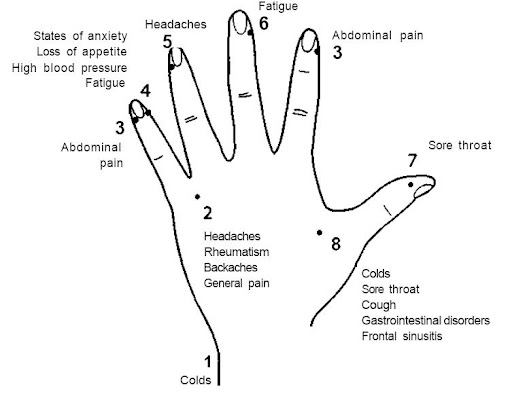
If vou have high blood pressure, massage the middle finger from the root to the tip. To counteract low blood pressure, massage the middle finger from the tip to the root. Do the same with the index finger if you have diarrhea or constipation.
Monday, August 18, 2008
Yoga Mudras and Healing Emotional problems
Mudras do true wonders in this field. For a number of years now, hand exercises have been successfully used on children in special education classes. Run your thumb along your fingertips in a gentle and conscious way.

This feels wonderful! It's refreshing for your brain. The brain should be trained like a muscle every day. It has been proved that even after a few days of rest in bed (after an operation, for example), the activity of the brain is reduced. It has also been demonstrated that the brain can regenerate very quickly through the appropriate training. Practicing mudras can be called pure brain training. There is a positive influence on the brain waves, particularly when the fingertips touch each other. When we visualize inner images at the same time, this requires a great deal of ability from the brain and promotes the power of the imagination. This power is one of the reconditions for mental alertness and clear thinking.
The accompanying affirmations promote a clear manner of expression, which is also a mental power. When a mudra is done with full concentration, and a state of serenity is maintained, cerebral activity is
calmed and regenerated. In addition, many mudras synchronize the right and left hemisphere of the brain. This promotes memory, the general ability to recollect, and, miraculously, creativity as well. I will risk claiming that a trained brain remains fit up into a ripe old age. The great yogis have also demonstrated this to us with their mental
alertness as seniors. I can also observe—and my surrounding world has confirmed this—that my own ability to recollect, my memory, clear thinking, and concentration have never been so pronounced as today. Colleagues who are as old as I am complain about the opposite. And I am no more talented than they are! The only difference is that I constantly train my brain. Always see the good in your fellow human beings, put the negative aspects of the past behind you, live completely in the present, and make the best you possibly can of it. Expect the best from the future and remain in constant contact with cosmic consciousness—then nothing will stand in the way of a meaningful and happy life. I can hardly describe the blessings that this kind of constructive thinking has brought me. Incidentally, this attitude in life is also the best for my health. Mudras have a wondrous effect on the emotional area of our lives, which includes the soul, our feelings, and our moods. It is no coincidence that people make fists when they are vehemently agitated, or that hands become limp and their movements flighty during depressions. If we want to change oppressive moods, we can do so by changing our breathing rhythm accordingly. The way we breathe can stimulate us, calm us, inflame us, or cool us down.
Using Yoga Mudras to heal physical complaints

Mudras used against a great variety of health disorders are primarily found in Chinese medicine. These usually have their origin in the Five Element Theory , the principles of which are still unknown in the West. However, the Indian yoga master and healer Keshav Dev, who intensively researched the effect of the mudras many years ago, can also confirm the healing power of the mudras. He says: "Your destiny lies in your hands, and this should be taken quite literally. Not only because the hand lines show the past and future of a person, but above all because each finger has its very own functions and power within the organism. If you know how to use this power, you can maintain your physical health and mental peace. When I tell patients about the mudras, their first reaction is skepticism. They ask me, 'How can my illness be improved if I do nothing more than just press together a few of my fingers?' But as soon as they begin to trust and have carried out the exercises, they feel the effect and their skepticism changes into astonishment. Then I explain to them that these techniques, which look so simple, are extremely valuable gifts that were given to us from the most enlightened yoga masters of ancient times."
Everyone who has been involved with the healing effect of the rnudras emphasizes that a sensible lifestyle and diet must absolutely be taken into consideration. An unhealthy lifestyle usually consists of inferior diet, lack of exercise, and too little fresh air, rest, and relaxation—coupled with too much stress, worry, negative thoughts, and negative feelings. Practicing the mudras, together with a healthy diet, routine rest periods, adequate exercise (yoga, jogging, hiking, biking, etc.) will naturally lead to an optimal lifestyle. And this is the basis for health. (
When mudras are used to support the healing of chronic health disorders,
they should be routinely employed as a course of treatment over a period of several weeks or months. A chronic disease has already had its beginnings within a person many years before it actually becomes evident. Consequently, a certain amount of time is required in order to dissolve the waste materials that have deposited themselves in the arteries, organs, individual
cells, and energy fields.
Some mudras can also be used as help in an emergency (for example: lumbago, dizziness, nausea, or heart attack). Practice these when they are necessary and only as long as they are necessary. Sudden complaints are not a coincidence, but are the explosion of an imbalanced state that has already flared up within us for a longer period of time. This is why a mudra shouldn't just be used like a fast-acting medication to subdue symptoms. Get to the bottom of the matter. Meditate- ask inside yourself what this physical attack means for you. Ask persistently and honestly, for then you will also receive an honest answer. Perhaps it won't be comfortable, but it
will have a healing effect in the long run.
Yoga- mudras and colors
Colors influence our minds and our lives on every level. In color
therapy, various shades of color are specifically applied to regener-
ate the organs and glands, as well as to activate the processes of
elimination, respiration, and circulation. Colors also influence our moods
and every type of mental activity.
• Red stimulates the circulation, makes us alert, warms and
relaxes, but can also bring out aggression;
• Orange improves the mood, promotes lightness, stimulates
sexuality, but can also stimulate superficiality;
• Yellow stimulates digestion, makes us mentally alert, and lets
life appear in a bright light, but it can also be obtrusive;
• Green is generally calming; it regenerates on every level, and
gives us the desire to start something new;
• Blue is also calming, but this calmness goes deeper and pro-
vides a sense of security; it conveys protection, and symbolizes t
the silent yearning for the incomprehensible;
• Violet is the color of transformation, change, and spirituality;
• Brown is the color of stability and connection to the earth, but
too much can lead to stagnation;
• White bears the entire spectrum of the other colors within
itself, containing birth as well as death;
• Black is the color of protection, of gathering strength, of
retreat, and of the emptiness that already bears abundance
within itself. Many teenagers like to wear black because they
stand at the gateway of a new period of their lives. However,
too much black weakens the organism, puts us in a sad mood,
and promotes pessimism.
There are basically no "bad" colors, but it is important to use the right pro-
portions. Every color can also be seen in our aura or energy body. When a
color gains dominance or is not in its right place, it will initially have an
effect on the general feeling of well-being. With time, a health disorder
may develop as a result. However, the course of an illness can also be
reversed with the help of colors.
It would go beyond the scope of this book to discuss the entire spectrum of colors used in healing. The following suggestions can help you have some good and beautiful experiences using color meditations. If you prefer a certain color, it may well be that you need the corresponding qual ities. However, if you give too much preference to one color, this can develop into an addiction and the color may harm you.
While holding a mudra, you can either visualize a color or concentrate on the color of an object. The first approach is better because the color will then come to life, which means you can imagine the color as dark or light, dull or bright, connected to forms, or flowing, etc. For example, you feel the need to go into the forest because you can best regenerate yourself there but don't have the time to do so. You can imagine a very green forest, and in your thoughts, you can totally luxuriate in the green of the leaves. This will refresh you inwardly. Such visualizations have long been used successfully, and pictures of lush landscapes are specifically installed in many hospitals to support the healing process. Try it out!
Sunday, August 17, 2008
BREATHING, VISUALIZATION, AND AFFIRMATIONS TO ENHANCE THE MUDRAS
The effect of a mudra can be immensely intensified with the breath. This is why it is very important to know what breathing does. When you understand the following principles, then you
can influence the effect of a mudra according to your own needs.
• Pay attention to a symmetrical posture and hold your arms about one inch away from your body. Even this position alone brings a sense of inner equilibrium and harmony as it regulates
the activity of the nervous system and hormonal glands.
• In addition to carbon dioxide, we also discharge expended energy on the subtle level when we exhale deeply. This is why you should always exhale vigorously several times at the beginning of a mudra. Make room for what you want to achieve.
• Always lengthen the little pause after inhaling and after exhaling by several seconds. This is the most important aspect of the breathing process. The inner powers are developed
during the pauses—on every level.
• When you practice a mudra to calm yourself, then slow your breathing.
• When you practice a mudra to refresh yourself, then intensify your breathing.
• The optimal quality of breathing is achieved when the breath is slow, deep, rhythmic, flowing, and fine.
At the beginning of a mudra meditation, exhale vigorously several times and then let the breath become deeper and slower. You now have three possibilities:
First: Focus on your hands and fingers, perceive the gentle pressure
where they touch each other;
Second: While inhaling, you can press the fingertips together a
bit more and let go of the pressure when exhaling;
Third: You can do it the other way around and apply a bit
more pressure while exhaling and let go of the pressure when
inhaling.
Every variation has its special effect. The first variation centers, creates inner equilibrium, and builds up strength in general. The second variation strengthens the will and refreshes. The third variation calms and relaxes. Try out these variations and feel the difference yourself! It is possible that you won't immediately feel the effect, but it is still there. The outer circumstances of our lives usually shape themselves according to our imagination and the contents of our minds. So we have the possibility of shaping our inner images in such a way that we enjoy life, experience success in our work, and have relationships on a loving and understanding basis. It is very important to create an unshakable faith and be filled with both fervor and serenity to accompany our self-made images.
We need to create little experiences of success for ourselves, since what functions in a small way will also succeed on a larger scale. We can slowly build and develop this confidence. Just imagine what would happen if a great many people would simultaneously imagine a beautiful world with
rich flora, content animals, happy human beings, and firmly believe that this is possible. Join in—then there will already be two of us!
If we can clearly express what we do not want and definitively formulate our wishes and needs, this can already be the beginning of a new order in life. For many years now, I have worked with affirmations— sometimes more, sometimes less. Time and time again, their astounding effects have astonished me. For example, my kitten disappeared one day. I repeated the same sentence over and over the entire day: "With divine strength and power, I find my kitten again." Toward evening, I simply knew where my kitten was. The woman was completely perplexed when I claimed that my cat was in her garage, but it was true. It is so simple, and some people even find it a bit naive. But things that are particularly simple and naive usually have the greatest effective power. The same principle applies to affirmations as it does to visualizations. Say them full of faith, fervor, and serenity. You can say them one to three times, during or after the meditation. You can also pause for a moment during the day and speak your affirmation in a quiet or a loud voice. Make use of this wonderful possibility and talk yourself into what you really want—what is good for you. If you want to get rid of something stubborn, a negation can also be helpful. Speak it at the beginning, while you are vigorously exhaling. For example, "This hatred (or resentment, feeling of guilt, pain, fear, desire to smoke, etc.) will immediately disappear and dissolve itself"
How Long is a Yoga Mudra Held?

The great masters do not agree on the length of time to practice a mudra position. The Indian mudra researcher Keshav Dev recommends holding one mudra per day for 45 minutes; chronic complaints can be eliminated in this way.6 If it isn't possible to do this, these 45 minutes can be divided into three time periods of 15 minutes each. The kinesiologist Kim da Silva, who has tested the effect of mudras over longer periods of time, recommends an individually, precisely determined time for holding each mudra. If you use a mudra as support for some type of therapy or to heal a chronic complaint, then I think it is beneficial to use it routinely, like a medication: every day at the same time and for the same length of time. Mudras that are used for acute complaints—such as respiratory and circulation problems, flatulence, exhaustion, or inner restlessness—should be discontinued when the appropriate effect is achieved. Other mudras can be practiced for 3 to 30 minutes, two to four times a day. Using a stopwatch is the ideal way to time them. The time specifications that I have assigned to the individual mudras are meant to be an orientation aid, but not a dogma. You will also notice that your hands, especially the fingers, will become increasingly sensitive and respond to the mudras much more quickly after they have been given some training. If you need 5 minutes at the start to feel the effect of a mudra, in time you will only need 10 breaths. This is a wonderful experience! However, if you are confined to your bed, then you have enough time and should permit yourself to make good use of it. Also let the visualizations and affirmations continue to have their lasting effect afterward. You can use this time for your own benefit, for the healing of the body, mind, and soul.
The effect of a mudra may be perceived immediately or only after a certain amount of time. You start to feel warm, the sense of unwellness and pain fade away, your mood improves, and your mind is refreshed. But exactly the opposite may occur at the start. You become tired, or start to feel cold and shiver. This is also a positive sign of the effect.
What are mudras in Yoga?

Mudra is a term with many meanings. It is used to signify a gesture, a mystic position of the hands, a seal, or even a symbol. However, there are eye positions, body postures, and breathing techniques that are called mudras. These symbolic finger, eye, and body postures can vividly depict certain states or processes of consciousness.
Conversely, specific positions can also lead to the states of consciousness
that they symbolize. What does this mean in concrete terms?
For example, a person who frequently and fervently does the gesture of
fearlessness, which can often be seen in the depiction of Indian deities, will
also be freed from fearfulness with time. So mudras engage certain areas
of the brain and/or soul and exercise a corresponding influence on them.
However, mudras are also effective on the physical level. I discuss this in
the section called "Mudras and Other Hand Therapies."
We can effectively engage and influence our body and our mind by
bending, crossing, extending, or touching the fingers with other fingers.
Isn't this wonderful?
In Hatha Yoga,1 there are 25 mudras. These also include eye and
body positions (asanas) and locks (bandhas). In this book, I will only briefly
touch on them and mainly describe the hand mudras. Especially in Kundalini Yoga,2 the hand mudras are used during the body postures to
intensify their effect. The kundalini expert Lothar-Riidiger Liitge
explains: "In this respect, Kundalini Yoga assumes that every area of the
hand forms a reflex zone for an associated part of the body and the brain.
In this way, we can consider the hands to be a mirror for our body and our
mind."
As I recently meditated on the term mudra, I became particularly
aware of the symbol of a lock. A lock always conceals a secret. We frequently
use gestures in an unconscious way to seal something; for example,
when giving special weight to a decision, or reaching an agreement with
another person, or even with cosmic consciousness. In precisely the same
way, we may also seal something with our inner forces—we reach an understanding
with ourselves. I don't believe we will ever completely understand
the essence of the mudras. The enigmatic touches on the Divine—so each
mudra ultimately creates a special connection to cosmic consciousness (or
however you prefer to call the Divine). This symbolism, in particular, is the
basis of the best-known hand mudra of yoga, the Chin Mudra.
The thumb is symbolic of cosmic (divine) and the index finger is symbolic of individual (human) consciousness. The ultimate or primary goal of yoga is the oneness of humanity with cosmic consciousness. With this gesture, the human being expresses this desire, this longing. It is interesting to note that both these fingers belong to the metal element in
Chinese Five Element Theory (see Appendix C for more about this topic).
Metal is the material that is the best conductor—it conducts energy.
According to this teaching, the metal element also creates the connection
with the cosmic world, and inspiration and intuition dwell in this element.
The index finger represents inspiration (energy from the outside) and the
thumb stands for intuition (inner energy). In this gesture, intuition and
inspiration form a closed unity. The power of the microcosm and the
macrocosm are connected and mutually fructify each other. We see that if
we dig into the depths of the ancient teachings long enough—or go far
enough into the heights—we will find ourselves at the other end again.